How to Build a Successful Essential Oil Brand With Private Labelling
- Blog
- How to Build a Successful Essential Oil Brand With Private Labelling
- Admin
- 29 Sep, 2026
Discover how to build a successful essential oil brand through private labelling. Learn about product selection, branding, packaging, reliable manufacturing partners, pricing strategies, and effective marketing techniques to grow your essential oil business.
This is one of the emerging trends that could potentially grow the essential oil market. Previously, essential oils have been limited to hair and beauty salons, being used in massages and spa treatment rooms for skin conditioning and exfoliating as well as for their aromas in aromatherapy and home fragrances. To-day, they are being discovered and savoured for their inherent aromas.
Building a successful brand requires more than selecting popular oils and creating attractive packaging. Businesses must focus on product quality, reliable manufacturing, brand positioning, customer preferences, and consistent supply. Private label for essential oils can take some of the pressure off of you by allowing entrepreneurs to deliver products under their own brand name, without a manufacturing plant.
Businesses can build their own unique essential oil lineup and improve their brand and customer base if they get the right manufacturing partner and follow the correct steps with their business plan. Once you know what to do, your business can change into a successful essential oil brand.
Understanding Private Labelling in the Essential Oil Industry
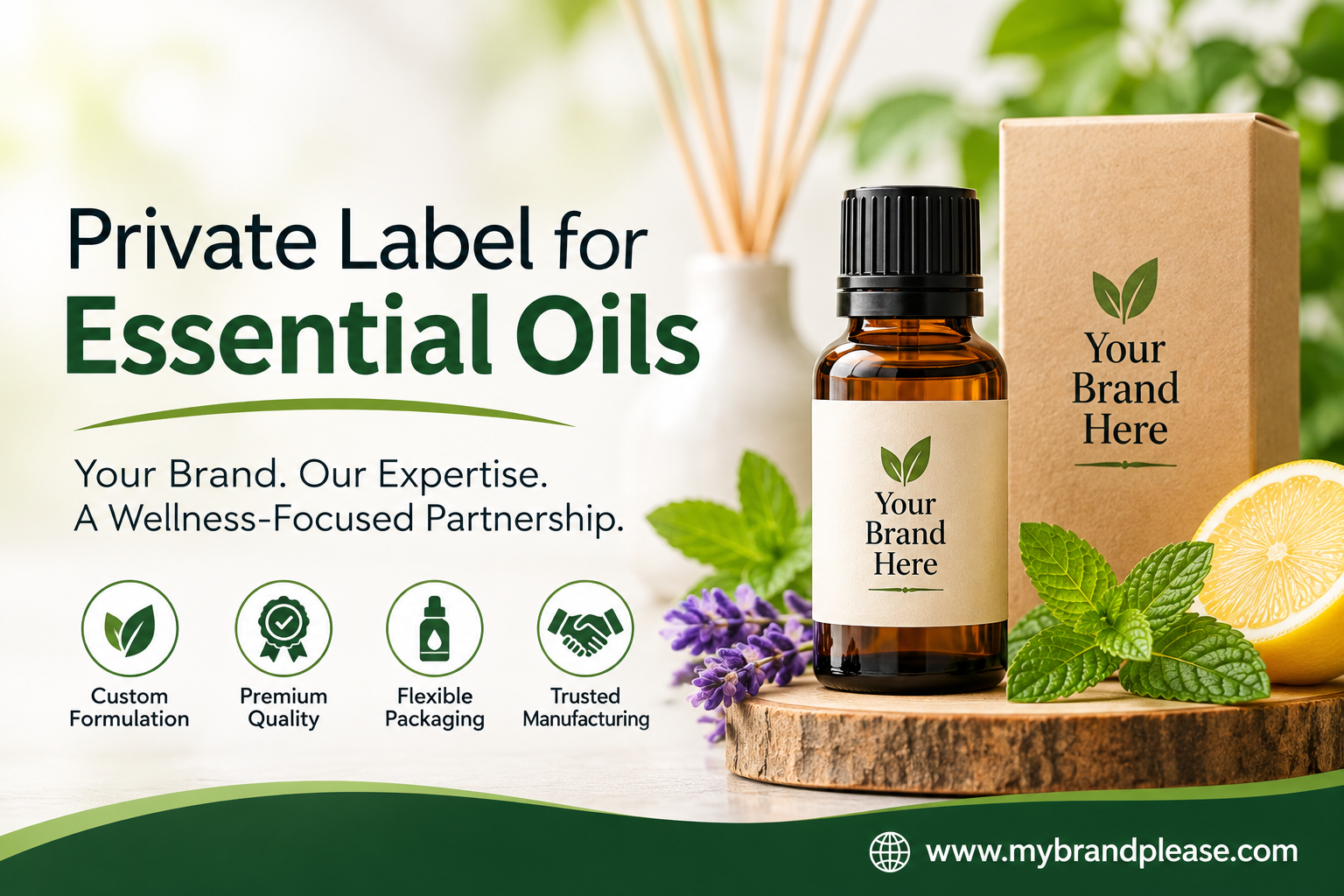
Private Label Essential Oils is a manufacturing and branding partnership where the private label company has its products made by another company and sells them under its own brand name. The essential oil industry private labelling involves companies selling single origin oils, blended essential oils and aromatherapy products under their brands.
Private label essential oils enter the marketplace without establishing expensive production equipment, infrastructure, and technical capability. Focus on choosing products, marketing and branding, and acquiring customers.
The private labelling partner may have been involved in one or more steps such as sourcing ingredients, formulation, filling, packing and labelling. Based on the manufacturing facilities, there are opportunities for businesses to manufacture customised blends and packagings to match their branding as well.
Benefits of Building an Essential Oil Brand Through Private Labelling
Start an essential oil business with a private label for essential oils. Choose to work with professional manufacturing companies and let your business focus on growth.
Lower Initial Investment
Finance to set up an independent manufacturing plant includes machinery, factory space, raw material inventory, and specialists. Private labelling lowers the bar by enabling companies to utilise manufacturing facilities already in place. This brings the world of essential oils within reach of small and growing businesses.
Faster Market Entry
Products can also be created on your own with time-consuming researching, tests and also manufacturing prep work. A private label for essential oils supplier understands the procedures and also can prep products and also test them swiftly, so you can introduce your series of products to your clients more rapidly through less effort on your part.
Custom Branding Opportunities
The marketing of a brand identity also affects the buy decision. The company has control over the name of the brand, the logo and product design and packaging, along with other factors like the display of products. This collection helps to build recognition.
Access to Manufacturing Expertise
A seasoned supplier of private label for essential oils will be able to advise you on sourcing ingredients, manufacturing knowledge and recommendations for formulating and quality control, to enable you to build products for your target market.
Flexible Product Selection
Start with a few best-selling essential oils and grow their inventory over time. If production capacity allows and if minimum order quantities are not prohibitive, companies might also have a larger range of scents, blends, packaging sizes and forms.
More Emphasis on Business Expansion
With our professional manufacturing work for private label essential oils, business owners can concentrate on communicating with retailers and customers, promoting their products online, and providing better customer service. Two tasks combined can make the business run smoothly.
Why Choose Us?
Choosing the right manufacturing partner is important to help you on the road to building an essential oil brand. mybrandplease specialises in assisting a company to build their own product lines via private labelling with options for product formulations, branding and eye-catching packaging. Product quality, ingredient transparency and manufacturing help to make your product your own.
For startups just stepping into the natural wellness industry and for companies looking to branch out into new products, a partner can help ease the development process. With a collaboration with a private label for essential oils, companies can dedicate time for customer outreach, marketing, and growing their brand while a team of manufacturing specialists creates a line of market-ready products.
Process of Building a Successful Essential Oil Brand
A formal sequence of the stages is required to launch a brand. They all are used in product creation, differentiation and to determine how long the business will last.
Research Your Target Market
Decide on the type of customer you would like to target. Find out about their purchasing habits and their interest in essential oils. Discover whether your target market is aromatherapy clients, skin care lines, health stores or end consumers who want to purchase private label essential oils.
Market gaps and differentiation opportunities can also be found with competitor research.
Select Your Essential Oil Products
Select the products that are based on the needs of your customers and your brand's positioning. There are some good options that you can consider: lavender, peppermint, rosemary, eucalyptus, lemon, and tea tree essential oils.
Think about if you want to sell single oils, signature blends, or gift boxes through a private label for essential oils. Begin with a small selection of products rather than a wide variety.
Find a Reliable Manufacturing Partner
Identify those manufacturers that meet your needs in production, sourcing ingredients, customisation and packaging. Ask for samples of their products and required documentation of quality before committing.
An honest partner will help facilitate private label for essential oils by offering flexibility to accommodate your various production needs, along with ensuring consistent product quality from batch to batch.
Develop Your Brand Identity
Design a catchphrase, logo, colour palette and packaging design for your brand. Your branding will tell people what your products are and how they're meant to be used.
For instance, a luxury wellness company offering a private label for essential oils might choose sleek, modern packaging; a natural company could opt for illustrations of herbs, flowers, or other plants with green, brown, or natural colourings.
Packaging and Labelling
Product protection is enhanced by the attraction of the end product by packaging. Choose the most appropriate bottles, lids and labels for each oil.
Require a private label for essential oils to feature the relevant information, such as the identification of the product, the list of ingredients, net quantity, manufacturer or responsible business, batch identifier, usage instructions and warnings. The requirements may be different by country and based on the product's claim.
Establish Your Pricing Strategy
Determine costs of products, packaging, shipping, marketing and distribution markups prior to setting retail prices.
Pricing should be set in proportion with the position of your product and on a benchmark price; find a reasonable level for a profit/customer value trade-off, having assessed similar products in the marketplace.
Launch and Promote Your Brand
Build a website and create an account on social networks and markets optimised for the sale of your private label for essential oil products. Build a web page for your brand and a selling point for your essential oils on online markets. Publish educational content about choosing products, features of each essential oil and safe and effective usage.
Plus, you can promote your product to wellness retailers, spas, aromatherapists and retail vendors.
Monitor Customer Feedback
Get customer reviews and monitor your sales after releasing your private label for essential oils. Find out your top-selling products and customer requirements, and make improvements according to actual customer reviews.
Softly introduce products once there is demand from the market.
Conclusion
There are many factors to take into account when creating an essential oil brand, such as the planning process, product expertise, branding, and sourcing a reliable manufacturing partner for private label essential oils. Finding the ideal clients, selecting the right products, and creating a powerful brand can be the first steps to success.
An easy entry to the natural wellness industry without the need to set up a manufacturing plant. When you partner with the right manufacturing company, you get to focus on the positioning of the product in the market, distribution channels, marketing and customer relationships.
At the heart of quality, strategic packaging, transparent labelling and beautiful products, the companies offering private label for essential oils could always put the customers first and make way for sustained success.
FAQ
What is private labelling in the essential oil industry?
With private labelling, a business can buy products that are already made by an external manufacturer and sell them under its own brand name. It can help you create a range of products around a specific theme or concept.
Is private labelling a good fit for essential oil start-ups?
Yes, if they are able to set up manufacturing. This is because they won't require much manufacturing infrastructure and can concentrate on choosing products, branding, marketing and distribution.
What are popular oils for private label?
Popular ones include lavender, peppermint, eucalyptus, rosemary, lemon and tea tree. Choose a product based on your customer base and where you want to position the business.
Can I customize the packaging of my essential oil products?
Yes, you may be able to customise the bottle sizes, labels, logos, colours, packaging, and product presentation. The options you may have will depend on your manufacturing partner.
How do I choose the right private label manufacturer?
Before deciding, consider the manufacturer's knowledge, how the ingredients are obtained, Quality assurance procedures, product records, flexibility, cost and manufacturing ability.
How can I promote my essential oil brand?
My health brand through Search engine optimisation, education blogs, social media marketing, influencer outreach, online marketplaces and health vendors.