How Growing Brands Can Build a Successful Essential Oil Line
- Blog
- How Growing Brands Can Build a Successful Essential Oil Line
- Admin
- 11 Aug, 2026
Discover how growing brands can build a successful essential oil line through private label manufacturing. Learn about product selection, customization, packaging, quality control, and the complete private label process. This guide also explains how working with the right Private Label Essential Oil Supplier can help businesses expand their product range, maintain consistency, reduce manufacturing investment, and focus on branding and marketing.
The essential oil market is playing a vital role in the personal care, wellness, beauty and lifestyle segment. Essential oils are used in a variety of products, including hair, skin, bath, massage blends and home fragrance solutions, and are becoming more popular with consumers as they look for products to fit into their daily routine.
Targeted product development under one's own brand could be a viable approach for businesses wanting to enter or grow in this market to establish a familiar product line. When working with a dependable private label essential oil supplier, brands can create essential oil products without having to handle every stage of the manufacturing process.
Private label manufacturing can assist companies in concentrating on branding, packaging, marketing, and customer relationships while the manufacturing partner takes care of the product tasks and production needs. The right supplier is important, though, as the quality of the product, its formulation, packaging, documentation and consistency can affect the overall success of an essential oil brand.
Understanding Private Label Essential Oil Manufacturing
Private Label Essential Oil Supplier refers to a manufacturing process where the product is created for a marketing entity, which then brands the product for its own use. In the essential oil business, it can refer to single oils, blends, and essential oil products that have been formulated to meet a brand's needs.
A Private Label Essential Oil Supplier can offer assistance at various stages such as product selection, formulation, packaging, labelling, and production. The specific services offered will vary by supplier and type of product being developed.
This model can be appropriate for startups and also established companies desiring to broaden their product line without establishing their very own production facilities.
Why Brands Choose Private Label for Essential Oils
When you're creating your own product line, you may be thinking about using Private Label for Essential Oils for a myriad of reasons.
Faster Product Development
Creating a product from scratch is a time-consuming and expensive process. By collaborating with a proven manufacturing partner, many aspects of development can be made easier and brands can get from concept to product much quicker.
Brand Ownership
Private Label Essential Oil Supplier companies to put together products that are marketed under their brand names. Packaging, product presentation, labeling and marketing can be tailored to the company's positioning.
Flexible Product Selection
Brands are able to choose from various essential oils and blends with regard to their target market. Depending on the supplier's capabilities, businesses could be able to create products for lifestyle, aromatherapy, personal care, beauty or wellness.
Reduced Manufacturing Investment
The investment needed to construct an in-house manufacturing facility is for equipment, raw materials, production systems, testing, storage, and people. Private label manufacturing is an option for companies that would like to work with a proven production partner.
Choosing the Right Essential Oils for Your Brand
One of the most critical activities in range development is product selection. Each oil has a variety of properties, scents and uses.
Some of the most popular essential oils are lavender, peppermint, tea tree, eucalyptus, rosemary, lemon, orange and other plant oils. The manufacturers should select essential oils according to product positioning and/or market they wish to reach.
A Private Label Essential Oil Supplier is a good resource to have so that your business will know what options are available, and which of those options could be a great addition to your businesses upcoming essential oil lineup.
The key factors a brand needs to consider to decide on the range of products are sourcing, purity needed, aroma profile, packaging compatibility and how the product is to be used.
Product Customization and Formulation
Customization can be a part of a brand developing a line of products that distinguishes itself from generic products. Depending on the supplier's capabilities, businesses may have the opportunity of choosing the specific oils they want to use, making blends, changing product specifications or creating various packages.
Brands that have adopted the Private Label for Essential Oils may also be able to customize the bottle size, labels, outer packaging, colors, product naming and more.
A product brief that is clearly understood by the manufacturer is helpful. Target customer, product type, desired ingredients, packaging needs, quantity, and brand positioning are all aspects of the brief that can be included.
Packaging Options for Essential Oil Products
An essential oil product often is dependent on its packaging; not only for the appearance of the product, but also for its practical use.
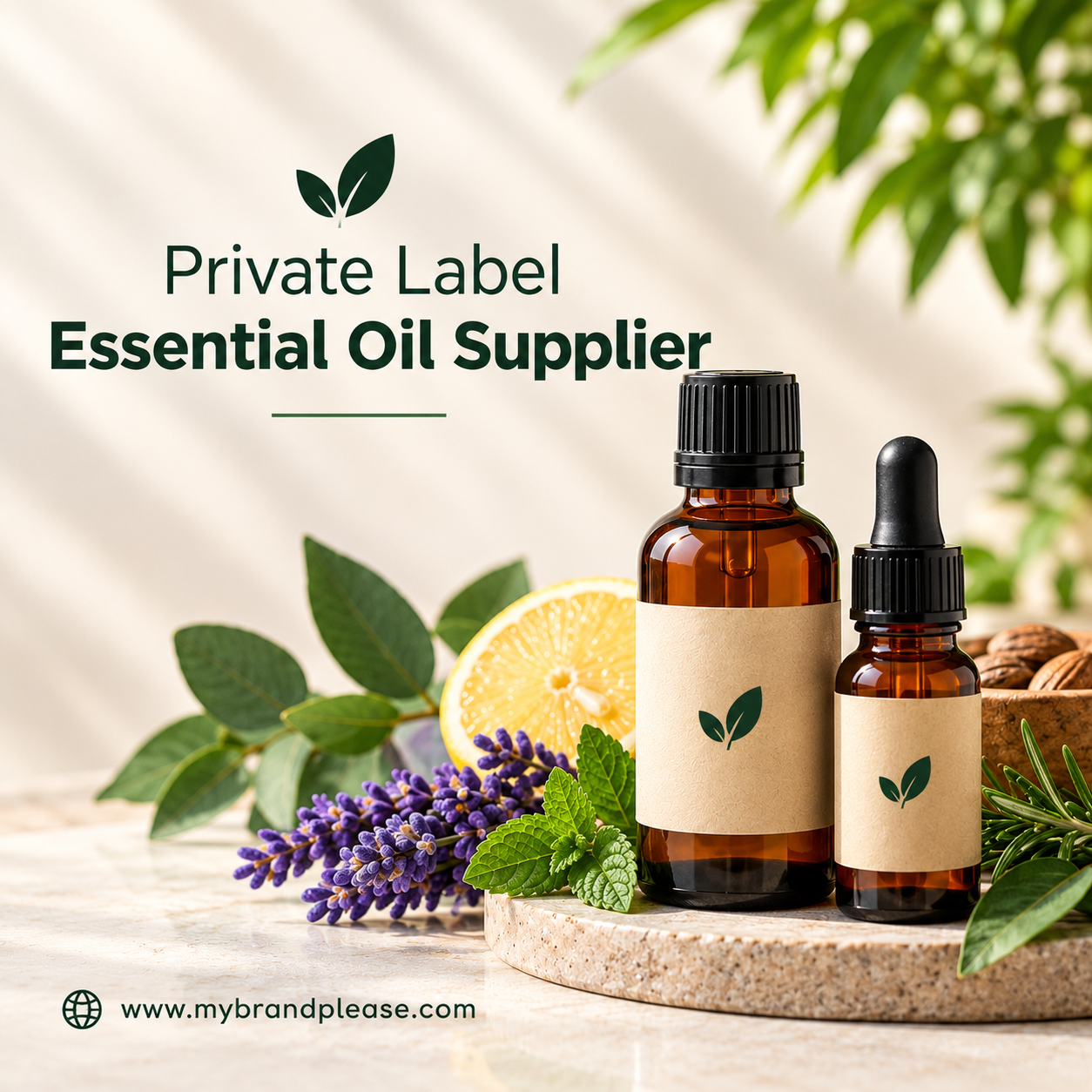
Essential oils are often sold in tiny bottles equipped with appropriate dispensing devices. Brands can select from a variety of bottle products, sizes, closures, labels, cartons or other packaging options, depending on the product and market.
A Professional private Label essential Oil supplier can assist in coordinating packaging based on the product specifications and brand requirements.
Packaging should also be designed to take into account the needs for clear information about the product and suitable labelling requirements. A consistent appearance throughout a product collection can be achieved through good packaging.
Significance of quality and consistency
One of the most crucial factors in creating an essential oil brand is quality. Purchasers will require uniformity in products from one buying to another.
Private Label Essential Oil Supplier needs to be reliable with the right raw material handling, production, filling, packaging and quality checking processes. Using consistent procedures can minimize differences between production runs.
Raw Material Sourcing
The raw materials are the foundation of the quality of an essential oil. The properties of the finished oil can be affected by the botanic origin, cultivation, extraction, storage and transport.
Brands should be aware of the source of essential oils and processing of the raw materials. A clear supplier can give valuable information on sourcing and product specifications.
In the context of businesses creating Private Label for Essential Oils, a responsible raw material sourcing can also help in building a better brand communication and customer trust.
Testing and Quality control
Testing is an important factor in product quality maintenance. Various testing methods can be employed to assess the characteristics of essential oils and verify product specifications depending on the product and requirements.
There are various types of quality checks that may be carried out on the raw materials, production batches, packaging, and finished product. Good documentation can also help businesses ensure that they have proper product information.
A Private Label Essential Oil Supplier with a robust quality management system can offer more transparency along the oil producing process.
Benefits for Growing Brands
For the growing businesses, private label manufacturing can prove very handy to avail manufacturing capabilities.
Supports Product Expansion
If the brand is already producing an oil, it can expand its product lines with additional oils or blends that it does not have to build itself.
Helps Maintain Brand Consistency
A coordinated manufacturing and packaging will help to ensure the collection's visual and product uniformity.
Allows Businesses to Focus on Marketing
With a specialist partner producing the Private Label Essential Oil Supplier, companies can focus more time on customer engagement, distribution, branding and marketing.
Suitable for Different Business Sizes
Startups, online companies, beauty, wellness companies, retailers and established brands looking to explore new product categories can all use private labelling.
How the Private Label Process Works
There are several stages in the process of private labeling.
Define Your Product Requirements
The first thing to do is to decide which Private Label for Essential Oils or blends to sell. Take into account who the audience is, product positioning, bottle size, packaging and anticipated quantity.
Discuss Specifications
Communicate what you need to the manufacturing partner. Talk about ingredients, formulas, packaging, labelling and quantities of production.
Review Samples
Private Label Essential Oil Supplier samples can be valuable to brands when deciding to go into full-scale production. This stage is there to review the product characteristics and packaging.
Finalize Packaging and Branding
Once approval of the sample product specifications is granted, the brand will be able to finalize its labels, bottles, cartons, and other packaging.
Begin Production
Once specifications and packaging are approved, production can commence based on the agreed production requirements.
Quality Inspection and Delivery
Finished products are subjected to necessary tests and quality control prior to packaging and shipment. Good coordination during this stage will be useful to ensure the end product is consistent with the approved specifications.
Building a Strong Essential Oil Brand
The Private Label Essential Oil Supplier, a successful product business is not the whole story. Thoughtful positioning, appealing packaging, informative product information and effective marketing are also important aspects of a strong brand.
Identifying the target customer and knowing what they look for in an essential oil brand are important things for businesses to consider. The same brand image should be used in product descriptions, packaging design, on the website, in social media communication and in customer service.
Consistency can establish brand awareness and highlight the product line.
Why Private Label Manufacturing Can Support Growth
Creating products under the Private Label for Essential Oils program can be a viable solution for developing new product offerings for growing businesses, and offer the benefit of maintaining the control of the brand presentation.
A business need not invest in its own manufacturing plant, but can collaborate with a well-established supplier and focus on adding value to the business in various other areas such as branding, distribution, customer relations, and marketing.
With the growing demand, companies can consider other products, packaging options, and other combinations of essential oils as required by the market.
Creating a Strong Manufacturing Partnership
A reliable Private Label Essential Oil Supplier will be mindful that each brand has unique needs. For some enterprises, private labeling might be a straightforward requirement, while for others it could involve more in-depth product assistance, customized blends, or packaging development.
mybrandplease is ready to offer private label manufacturing to companies who wish to create their own line of personal care and beauty products.
Businesses should discuss product specifications, quality standards, packaging, order amounts, documentation, and times with the supplier before choosing one. If there is an agreement at the start, it can help to produce a more streamlined manufacturing relationship.
Conclusion
As people become more interested in wellness and personal care, beauty and lifestyle products, there is room for brands to create their own set of essential oils. Private label manufacturing is a convenient method for companies to develop brand products without having to run a manufacturing facility.
By selecting the right Private Label Essential Oil Supplier, businesses can streamline their product development, manufacturing, packaging, and quality control processes. The entire process of choosing raw materials, through processing and final packaging, all of these factors influence the final quality and appearance of the product.
FAQ
What is a private label essential oil supplier?
A private label essential oil supplier will produce essential oil products that are then sold under a business' own label. This can involve product selection, formulation, filling, packaging and labelling.
Why is private label essential oils a must for brands?
Private labeling can decrease the need for an in-house manufacturing facility and enable businesses to develop products with their own brand name.
Are there any ways to customize essential oil products?
Businesses can customize product brands, blends, bottle size, labels, packaging and more according to the manufacturer's capacity.
What should I check before choosing a supplier?
Evaluate production capacity, quality control, supply of raw materials, customization, M.O.Q., packing, delivery time, and documentation.
Would private labels be helpful for a new business?
Yes. Private labeling can give startups and growing businesses access to existing manufacturing facilities and let them concentrate on the branding, marketing and sales.